Research

Dense aggregation under a drifting FAD
Work areas

Research

Developing improved approaches for scientific analyses to support fisheries management

Our Stock Assessment and Modelling (SAM) team engages in research to improve the analytical and modelling approaches applied to stock assessment and fisheries data analysis for oceanic fisheries in the western and central Pacific. SAM’s research involves both stand-alone funded projects with specific objectives, and ongoing work to refine and develop approaches, supported under our role as the scientific services provider (SSP) to the Western and Central Pacific Fisheries Commission (WCPFC). We collaborate with various organisations, including other regional fisheries management organisations (RFMOs), academic institutes, and national fisheries agencies throughout the Pacific and Asia.


Some of the areas of high research interest to SAM include:

  • Analysis of fishery dependent catch per unit effort (CPUE) data to provide abundance indices
  • Understanding and quantifying effort creep in tuna fisheries
  • Representation of stock assessment uncertainty in provision of management advice
  • Developing new features and refining the modelling framework MULTIFAN-CL
  • Spatially explicit stock assessment methods
  • Management strategy evaluation (MSE) and harvest strategies
  • Scientific computing for improving stock assessment efficiency
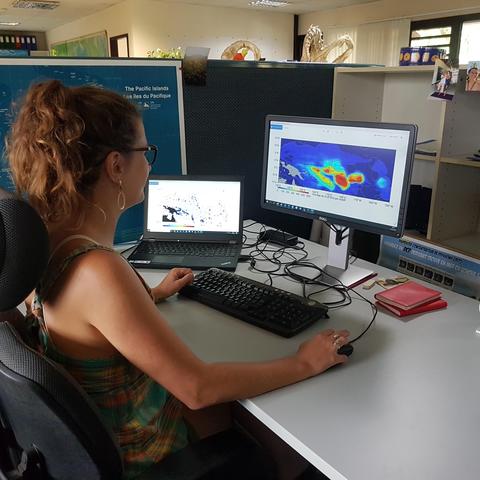
 

SPC fisheries scientist (purse-seine dynamics), analysing d-FAD data
SPC fisheries scientist analysing dFAD data

Our research activities extend beyond the realm of stock assessment. Of special note is our work in the area of drifting Fish Aggregation Devices (dFADs) for the world’s largest tuna fishery. These are used to attract tuna species (skipjack, yellowfin, and bigeye) that are then harvested by purse seine. Most dFADs are now equipped with electronic marker buoys that transmit their position data and sonar data of fish aggregations. This technology has transformed the operation of the tuna purse seine fisheries since the 2000s, but with various associated management and environmental issues. SAM’s research on dFADS has the following key focus areas:

  • Estimating the numbers and patterns of dFAD deployments in the western and central Pacific (WCPO)
  • Understanding and measuring the locations and rates of dFAD beaching in the WCPO
  • Exploring the use of the acoustic data collected by dFADs for fisheries monitoring and assessment
  • Developing and trialling biodegradable and non-entangling dFADs
  • Ecological risks associated with dFADs


Further to our work on dFADs, country specific fisheries research is regularly conducted based on requests from SPC member countries. This often involves novel analysis and data exploration to support country specific management and policy developments, including aspects of fisheries development, environmental impacts, and economics.

Related to this article

Escalle L., Scutt Phillips J., Pilling G. 2020. Beaching of drifting FADs in the WCPO: Recent science, management advice and in-country data collection programmes. SPC Fisheries Newsletter 160. Noumea, New Caledonia: Pacific Community. 9–14. https://purl.org/spc/digilib/doc/zaxq7

Escalle L. 2021. A novel approach to quantifying drifting fish aggregating device use in the Pacific. SPC Fisheries Newsletter 165:10–12. https://purl.org/spc/digilib/doc/5jomh

Lauriane Escalle, Steven Hare, Gala Moreno, and Paul Hamer (2021) Overview of ongoing work on FADs. Scientific Committee Regular Session, Online, 11-19 August 2021, 17th. https://meetings.wcpfc.int/node/12600

Lauriane Escalle, Tiffany Vidal, Beth Vanden Heuvel, Ray Clarke, Steven Hare, Paul Hamer and Graham Pilling (2021) Project 88 final report: Acoustic FAD analyses. Western and Central Pacific Fisheries Commission (WCPFC). Scientific Committee Regular Session, Online, 11-19 August 2021, 17th. https://meetings.wcpfc.int/node/12590

G. Moreno, J. Salvador, J. Murua, N. B. Phillip Jr., H. Murua, L. Escalle, B. Ashigbui, I. Zudaire, G. Pilling, V. Restrepo. 2020. A multidisciplinary approach to build new designs of biodegradable Fish Aggregating Devices (FADs) Western and Central Pacific Fisheries Commission (WCPFC). Scientific Committee Regular Session, Pohnpei, Federated States of Micronesia, 12-19 August 2020, 16th. https://purl.org/spc/digilib/doc/zzm6z

N. Ducharme-Barth and M. Vincent. 2021. Focusing on the front end: A framework for incorporating uncertainty in biological parameters in model ensembles of integrated stock assessments. Western and Central Pacific Fisheries Commission (WCPFC). Scientific Committee Regular Session, Online, 11-19 August 2021, 17th. https://purl.org/spc/digilib/doc/opqgp

Ducharme-Barth, N.D., Grüss, A., Vincent, M.T., Kiyofuji, H., Aoki, Y., Pilling, G., Hampton, J., Thorson, J.T., 2022. Impacts of fisheries-dependent spatial sampling patterns on catch-per-unit-effort standardization: A simulation study and fishery application. Fisheries Research 246, 106169. https://doi.org/10.1016/j.fishres.2021.106169

Ducharme-Barth N. 2022. What is CPUE standardisation and why is it important for stock assessments? SPC Fisheries Newsletter 166:45–49. https://purl.org/spc/digilib/doc/i3f3a

Tiffany Vidal, Marino-O-Te-Au Wichman, Paul Hamer, Graham Pilling and the PNAO (2021). Effort Creep within the WCPO Purse Seine Fishery. Western and Central Pacific Fisheries Commission (WCPFC). Scientific Committee Regular Session, Online, 11-19 August 2021, 17th. https://meetings.wcpfc.int/node/12591